Interview with Uli Jon Roth
Nov/Dec 04
by John Haseltine
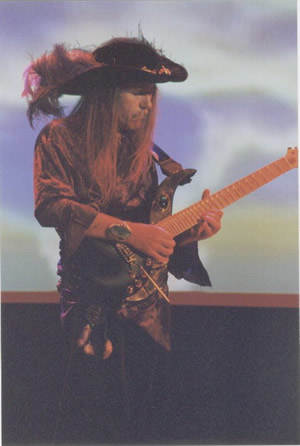 Uli Jon Roth is a multi-talented, multi-instrumentalist who write all his own musical scores and arrangements. Produces his own albums and directs his own videos. A true inspiration who has been cited by
countless guitarists from around the world as one of their major influences. Since his early days as one of the founders and main song writers for the Scorpions, Uli has been on a non-stop journey through music. From his band Electric Sun, to the Sky Orchestra and many notable European tours, Uli's road had not led him here to the states for over 19 years. Way too long if you ask me. I had a chance, an incredible chance to sit and talk with him after the show at The House Of Blues in Chicago. Truly a unique opportunity for myself. One which I will not easily forget.
Uli Jon Roth is a multi-talented, multi-instrumentalist who write all his own musical scores and arrangements. Produces his own albums and directs his own videos. A true inspiration who has been cited by
countless guitarists from around the world as one of their major influences. Since his early days as one of the founders and main song writers for the Scorpions, Uli has been on a non-stop journey through music. From his band Electric Sun, to the Sky Orchestra and many notable European tours, Uli's road had not led him here to the states for over 19 years. Way too long if you ask me. I had a chance, an incredible chance to sit and talk with him after the show at The House Of Blues in Chicago. Truly a unique opportunity for myself. One which I will not easily forget.
JH: Okay, we're rolling here.
UJR: So this is for?
JH: Ball-Buster.
UJR: Is that an online magazine or what?
JH: Both. Mainly online as well as there have been printings.
UJR: I've heard the name a lot, but don't think I've actually seen it.
JH: Well I'll have to show you one.
UJR: Is it like only in the states?
JH: No. I believe it gets distributed all over when one is done.
JH: Okay, my turn. How is it being back in the states after 19 years?
UJR: It's actually really, really nice. And very exciting. I was, and I am quite blown away by the response we're getting. I didn't expect this. I just thought , well a lot of my friends said that you gotta come back and you've got to play. I actually was not sure, cause I heard some things a few years back. You know that that kind of music is not happening anymore in the states.
JH: Is that the reasoning behind such a long wait to come back here?
UJR: No , no. it's just that, a lot of reasons. But this time, the time just felt right. And so we just went for it. And I'm glad we did. Hopefully we'll be playing again here next year. Because we've already had a lot of invitations to come and play again. So, yea it's really good.
JH: So the tour has been going really well then
?UJR: It's going really well.
JH: What inspired you to play guitar?
UJR: I guess it was the sound of the instrument at the time. I had started on some other instruments, like trumpet, and I played the bass. I than, I don't even remember, I guess , it was the neighbor kids. They played guitar and had a band and I just watched them and I fell in love with that instrument and started playing the electric guitar. So that's really what it was. It wasn't any particular moment I remember, it was just, it so happened.
JH: You always seem to be pushing the boundaries of your guitar playing. Is this just your natural creative process? Or do you just not like the same thing over and over?
UJR: It's something that's inside of me. I can't help it. I need to have the feeling that I'm going somewhere. And if I kept doing the same thing, in the same way, I would get very, very bored. And then it wouldn't feel right. So it's like an impulse. I can't really help it. It's just the way my mind works. I guess, you know?
JH: What inspired you to do Vivaldi's Four Seasons?
 UJR: That goes back quite awhile. We had an orchestra concert in Belgium. In I think the early 90's, and I had to do like a whole evenings worth of music. I thought it would be an interesting idea to do some of the classics, some of the great pieces. Violin pieces and classical pieces and do them on guitar. And the Vivaldi was one of them. So I did a few of these Vivaldi things, and then I thought, later on I thought it would be nice to do the whole, and then I had an opportunity to do that with an orchestra in Germany. And we recorded it. That was the foundation of this album. But, I guess that the more I worked with this piece, the more I began to admire it. Although it did click with me the first time, I don't know when I first heard it. There's something magical about it.
It's incredibly timeless. And I think that's what I responded to. Than once I started working with it, I found new angles to interpret it. Then I tried to go beyond the interpretation and do something "new" with it. Without hopefully, destroying the essence of the piece.
UJR: That goes back quite awhile. We had an orchestra concert in Belgium. In I think the early 90's, and I had to do like a whole evenings worth of music. I thought it would be an interesting idea to do some of the classics, some of the great pieces. Violin pieces and classical pieces and do them on guitar. And the Vivaldi was one of them. So I did a few of these Vivaldi things, and then I thought, later on I thought it would be nice to do the whole, and then I had an opportunity to do that with an orchestra in Germany. And we recorded it. That was the foundation of this album. But, I guess that the more I worked with this piece, the more I began to admire it. Although it did click with me the first time, I don't know when I first heard it. There's something magical about it.
It's incredibly timeless. And I think that's what I responded to. Than once I started working with it, I found new angles to interpret it. Then I tried to go beyond the interpretation and do something "new" with it. Without hopefully, destroying the essence of the piece.
JH: So that led to your latest concerto Metamorphosis?
UJR: Yes that came from that.
JH: You want to tell us a little about that?
UJR: It started very spontaneously. It was completely unpremeditated. It was to do with that orchestra show in Germany. Where I had to play the Four Seasons, when I was preparing it one day I just decided to do a little condensa at the end of it. And that condensa just grew into this concerto that just kept going and going. I really couldn't stop it. It just came out that way. It was unpremeditated. It just kept developing. I really couldn't do much about it. It just kept growing.
JH: You're also currently working on a film based around the music of Metamorphosis?
UJR: yes, I started that as soon as we finished the album, and I was looking for people to share the interest. I found them and I think we're hopefully going to complete it this year. It's an ongoing thing. We've done most of it. Recorded most of it, but there's still a few bits that need doing. Time is always the problem. There's just not enough of it.
JH: You are a man with many projects going. From what I understand.
UJR: Oh yea, and I like it that way. Otherwise I get too bored. I need to always switch between things. When each of the feelings are kinda fresh, and sometimes I just put it to the side. Then it kind of works itself in my subconscious , and then when I get back to it a few months later, it's like it has grown. And then I can just pick it off, like from a tree. But you know it needs time to mature. I can't really explain it. And I take that time ,and it works. It's always in bursts. So there'll be short bursts where a lot of stuff gets done and gets materialized, and then there's a couple of bits where there's a question mark. So I don't force these bits. I just let these answers come. That's why sometimes it takes longer. Because I just put it to the side and then suddenly, I wait till that moment, and then it's just right there.
JH: You also have a few books in the works? One titled The Metaphysics Of Music. Could you tell us about this?
UJR: Yes I've got quite a few going right now. That's actually quite a big project. I started that about 15 years ago. I'm still collecting the ideas for it. It's a subject that really fascinates me. To, I've read a lot of musicology and things. But there are also a few things I never read about. And that I wanted to find out about. And these are the things I keep concentrating on. So I come back to it again and again. Finding the answers, or looking for answers. But I don't know when that will be finished. Maybe when I'm 80? I don't know. But you know, I want it to be right. I'm not going to rush this one. Sometimes I'm rushing things, but not this one.
JH: How long of a process was it for you in finding the musicians for the Sky Orchestra?
UJR: That was actually quite easy. Because in London there's a great pool of orchestra players. I had a few friends who worked with me before and they're all orchestra people. And they played on these albums. When we recorded these albums, we recorded them with a relatively small, tight contingent. But then when we do it live, we augment it with other players. We have like a pool of players to choose from. That's the way it started. Sky Orchestra is more like a concept. It's an idea, because we're trying to do something, really that hasn't been done. In this way. Yea, I think that's the best way I can put it.
JH: It's very cool how you have them playing on the screen behind you.
UJR: I'm just trying to somehow, somehow augment the music visually. A little. Particularly the Vivaldi, well actually all my stuff is intensely visual. Whenever I'm writing, I'm always writing with a cinemascope screen in my mind. That's the way I do it. I just see these things. To me, like when you're doing something like the Vivaldi, or most classical music, it also has something festive about it. It's special. It's a little like going to church. You know I wouldn't like going to an orchestra concert, where there playing music that's like, like with the orchestra I wouldn't dig it if they were just sitting there like in jeans and t-shirts. It wouldn't show respect to the music. And I wouldn't want to do that either. So this is what I'm trying to do here. It's a little bit of time travel here. But I don't take it too seriously. So there renaissance costumes, but at the same time Vivaldi was actually baroque music. You can trace his music back to renaissance dances and such, but he was a hundred years later. I like to criss-cross the boundaries of time . All the time. Otherwise it would be just too small of a window. You know I like windows to be more wide and more open, and multi-dimensional.
JH: Tell us a bit about the legendary Sky Guitar.
UJR: Sky guitar. What you want to know?
JH: For those who are unfamiliar with it, can you describe it? When I found out I was going to get to interview you and meet you, I was very excited and told a bunch of people. When I did they were like, who?
UJR: (laughing) Uli who?
JH: So I'd like this to sort of reintroduce you to people, and or let some of the younger generation know who you are and what you've done.
UJR: And that's my doing. I haven't been around for so long. You know a lot of these kids weren't even born at that time. The Sky Guitar goes back a long ways. I believe I had the original idea back in '82. First one was built in '83. It developed through, well ever since the early Scorpions, I found that when I was soloing, playing a lead, very often the logic of the melody would demand to go a couple of notes higher then I could on the Strat. So I started to find ways to do that on the Strat. But there is a limit to how high you can go. So finally, I met this guitar builder and he said, hey, I can build you any guitar you like. That's what got me thinking. So I had this idea in my mind really, to give me more of a range. But at the same time having the same kind of feel that the Strat had. And I wanted the Strat, Gibson Les Paul sound at the same time. That's what these guitars give me.
JH: How many are there?
UJR: Uh, there's 5 official ones. But there's tons of copies.
JH: You're the only owner of the official copies?
UJR: Well,.Yea.
JH: Back in '98 you toured with the G3 Tour with Satriani. How was that? Did you do the whole tour over there with them?
UJR: We did all of Europe yea. Yea it was really fun.
JH: Doesn't Satriani play a seven string sometimes?
UJR: No, that's Steve Vai.
JH: Okay, I have to ask at least one question pertaining to your time with the Scorpions. You have really had, and are still having an amazing career and life with all you've done and are currently working on. Would you say if you've ever had any regrets of leaving the band? They went on to become such a huge international success for so many years.
UJR: No, I've never regretted it. I wasn't in it for that. From the beginning you know. I had a different perspective on things. A totally different perspective on things. It's something that was natural for me. Basically in the last year with the band, it came to a point where I really didn't enjoy it anymore. And I wanted to, explore music in a way that I couldn't with the Scorpions. That was the reason. But you know, it was all on the horizon. We all had gold albums after Virgin Killer, it was just going higher and higher, year after year. But I didn't want to miss the boat, musically. I wanted to do this. My motivation was not the financial success. It never was. So that's why it was a very easy choice for me. You know with Electric Sun, I got to do what I wanted to do. And it was also very successful. It wasn't as commercial as the Scorpions, but I was able to play the big halls, had great audiences, and I really enjoyed myself.
JH: How does it feel being such a big inspiration and influence on so many of today's musicians?
UJR: I don't know, it's just part of the story.
JH: Any words of advice for the starting musician?
UJR: Well you know, every player is different. I don't want to give any random advice. Everybody needs to find their own way. Deal with their own talent. Or lack of it. Some people have more talent than others, but some people play better with less talent ,than some people with more talent. It really depends on how you apply yourself. And how much you get in tune with the music. So I think the most important thing really is to, bottom line is get in tune with the music. If you go really deep, that's where it's at. Don 't just tinker with the surface. I think there's too many people out there and they have in the past. Particularly, in some rock bands where the outward façade of rock-n-roll became way more important then the essence of the music. That's a bit like a disease , and a trap to fall into. So people should stay true to themselves and find their destiny. And their way. I think that's good advice.
JH: On your website, you dedicate a large part of it to Monika Danneman. You credit her for inspiring you to be the artist you are today. Tell us how she made such a profound effect on you.
UJR: She was, yes she was tremendously inspirational. The thing is, she did learn a lot from Jimi, he told her a lot of things about the things I was just talking about. How to find yourself. How to channel these forces. And he gave her certain keys, to inspiration. And that's what she past on to me. It helped me. Enormously . Yea, certainly I wouldn't play the way I do if it weren't for her. Without that kind of knowledge. It also challenged me. Challenged me to get better. That's always good. You need to be challenged. Life without a challenge is boring I find.
JH: Yes, I have many.
UJR: Good for you.
JH: Any other words of wisdom?
UJR: Well I don't know if they're words of wisdom, but I think that was important. All that stuff. I don't know what your audience is like. What they're into. The way they think. Sometimes.
JH: Who really knows how anybody thinks?
UJR: Yea, you don't. you should, you should. But that's just easy talking. Sometimes I don't even know how my audience thinks. But I do listen to what they say. It's important that you need to tune into people. Listen to people. I find this very important. You know, really listen. Listen to what they're saying. A lot of people actually don't do that. They think they listen, then they don't actually hear what the person is saying. It's a big part of why the world is in such a mess today. Why it has always been in such a mess. Because everybody has their own agenda, and they kind of relentlessly are pursuing that and they don't tune into other peoples agendas. Which I guess is partially a human trait, it's one of the less good human traits. And we all share that to some degree. At some time or another.
JH: I admit to it.
UJR: Oh, so do I.
JH: Well it's pretty late. I appreciate your time tonight and it was a great show.
UJR: No, I appreciate you interviewing me. You know I'd like to connect with these younger audiences because , it's a totally different generation. It's interesting for me. That I can put my two cents in or whatever it is you say here in America.
